
Outsourcing your recruitment is a big decision.
- It impacts your hiring speed.
- Your candidate quality.
- Your client satisfaction.
- And ultimately, your revenue.
But here’s what many companies get wrong.
They choose an RPO partner based on cost alone.
And months later, they realize they didn’t choose a partner — they chose a vendor.
If you’re considering Recruitment Process Outsourcing, here are the essential questions every company should ask before making that decision.
1. Do They Understand Your Industry — Or Just Recruitment?
Recruitment is not one-size-fits-all.
Healthcare hiring is different from tech.
UK staffing is different from US staffing.
Permanent hiring is different from contract placements.
Ask yourself:
• Do they understand your market dynamics?
• Do they know your compliance requirements?
• Can they source niche roles confidently?
An RPO partner should understand your industry context — not just how to post jobs.
2. What Part of the Process Are They Actually Handling?
Not all RPO models are the same.
Some providers only do sourcing.
Some only screen resumes.
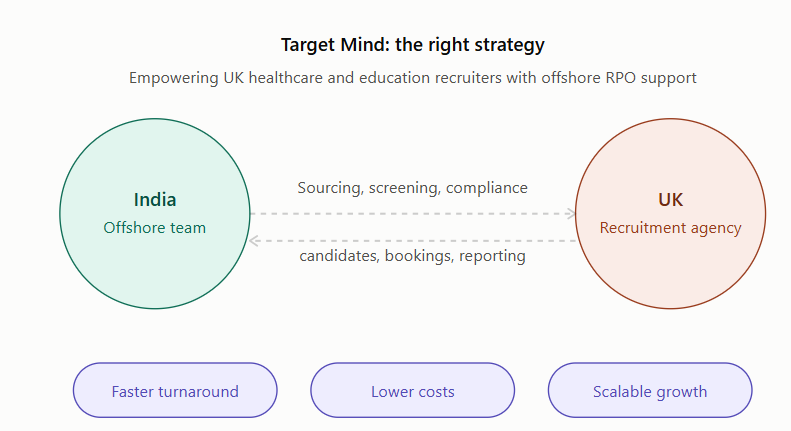
Some offer full end-to-end recruitment support.
Before signing, ask:
• Who handles sourcing?
• Who handles screening?
• Who coordinates interviews?
• Who owns candidate communication?
• Who tracks reporting?
Clarity here prevents confusion later.
3. How Do They Build Talent Pipelines?
A strong RPO partner doesn’t just react to open roles.
They build proactive pipelines.
Ask:
• Do they continuously source candidates?
• Do they maintain talent databases?
• Do they build pools for recurring roles?
If the answer is “we’ll start sourcing once you send requirements,” that’s reactive recruitment.
You need proactive systems.
4. What Technology and Reporting Do They Use?
Recruitment today is data-driven.
Your RPO partner should provide:
• Structured reporting
• Clear metrics
• Transparent tracking
• Defined SLAs
If you cannot see what’s happening inside the recruitment pipeline, you’re outsourcing blindly.
Visibility matters.
5. How Scalable Is Their Model?
Hiring needs fluctuate.
One month you may need 5 hires.
Another month you may need 50.
Ask:
• Can they scale up quickly?
• Can they reduce capacity when needed?
• How flexible is their team structure?
Scalability is one of the biggest advantages of RPO — but only if your partner is built for it.
6. How Do They Ensure Quality?
Speed is important.
But quality is critical.
Ask:
• How do they pre-screen candidates?
• What qualification filters do they use?
• How do they measure submission-to-interview ratios?
An RPO partner should improve candidate quality, not just increase volume.
7. Are They a Vendor — Or a Strategic Partner?
This is the most important question.
Do they:
• Provide hiring insights?
• Suggest improvements in your process?
• Help you forecast hiring needs?
• Identify bottlenecks proactively?
A vendor waits for instructions.
A partner improves your system.
The difference is massive.
The Real Risk of Choosing Wrong
A weak RPO partner can create:
• Delayed hiring
• Poor candidate quality
• Recruiter frustration
• Client dissatisfaction
• Revenue loss
Choosing the right RPO partner, however, can create:
• Consistent talent flow
• Faster placements
• Reduced internal pressure
• Scalable hiring systems
That’s why due diligence matters.
Final Thought:
Outsourcing recruitment is not just about saving cost.
It’s about building structure, speed, and predictability into your hiring process.
Before choosing an RPO partner, ask the right questions.
Because the right partner doesn’t just fill roles.
They build recruitment systems that scale.